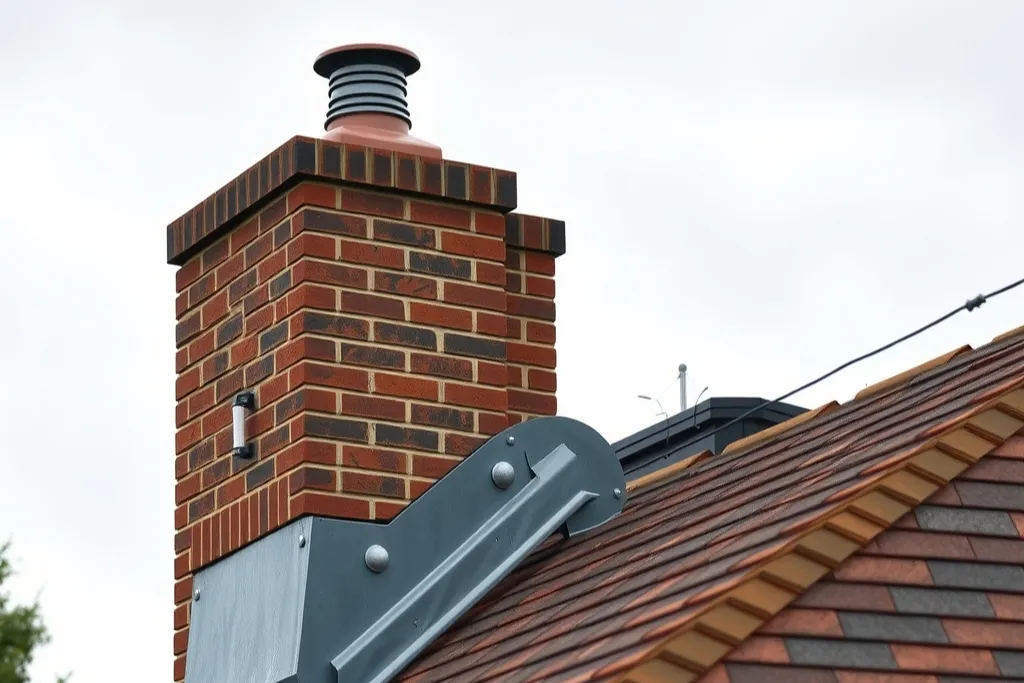
Why is a chimney so hard to keep dry?
A chimney stands above the roof in every weather, so its faces, crown and joints take the full force of rain, wind and snow. Where it meets the roof, two different materials and two different expansion rates have to be sealed to each other, and the joint is where the water tries to get in.
The masonry absorbs some moisture and releases it slowly, while the metal flashing expands and contracts with temperature. Over many winters the mortar at the flashing line can crack and open, and water finds the gap. A small crack in the mortar can let in enough water to stain a ceiling several feet away from the chimney.
The flue itself is a path too. Water that runs into the chimney cavity can travel down the inside of the flue and soak the masonry at a lower level. That is one reason a repair includes the crown and the joints, not only the metal.
Is the flashing or the mortar the problem?
Both can be the problem, and the repair checks each one before deciding. A leak that comes through the metal joint may need only new flashing. A leak that appears through the brick or along the flue may need repointing or a new crown, and sometimes both.
The test is to see where the water appears inside and where it runs outside. A stain that starts at the flashing line points to the metal. A stain that appears on the chimney face or deep in the flue points to the masonry. The technician looks at both, rather than assuming one.
Where the mortar is sound and the metal is correct, the leak is likely at a sealant or a lap that has failed. Those faults are small, but they are easy to miss without a look at the joint from above and below.
What does a repair on the masonry involve?
Repointing removes the failed mortar from the joints and fills them with new mortar matched to the old. A crown repair rebuilds the top surface so it slopes away from the flue, and any cracks are sealed. Both are masonry work and take the most time in the job.
New mortar should match the old in strength and color, because a mortar that is much harder than the brick can crack the brick as the wall moves. The crew checks the mix and the joint depth before pointing, so the repair lasts as long as the surrounding masonry.
A crown that is rebuilt needs time to cure before the metal is set against it. The order of work is planned so that the masonry is complete and dry before the flashing is fixed, and that sequence is recorded in the note.
Does a chimney repair need a permit?
It depends on the scope of the work and the local building department. The research did not establish the permit rules for each village or city in the county, so the answer for a given address comes from that office. Repairs limited to flashing are often simpler than masonry work.
A repair to a chimney crown or to a structural part of the masonry may be treated differently from a flashing replacement. The crew says which parts of the job are involved, and the homeowner can check with the local building department before work begins.
The masonry and the fire-safety condition of the flue are a separate matter, and a chimney that is in doubt for either reason should be inspected by a specialist before it is used. This page covers the water seal, not the flue's safety.